
Scarce labour
Farms struggle to find people for field work, and every season it gets harder to staff.
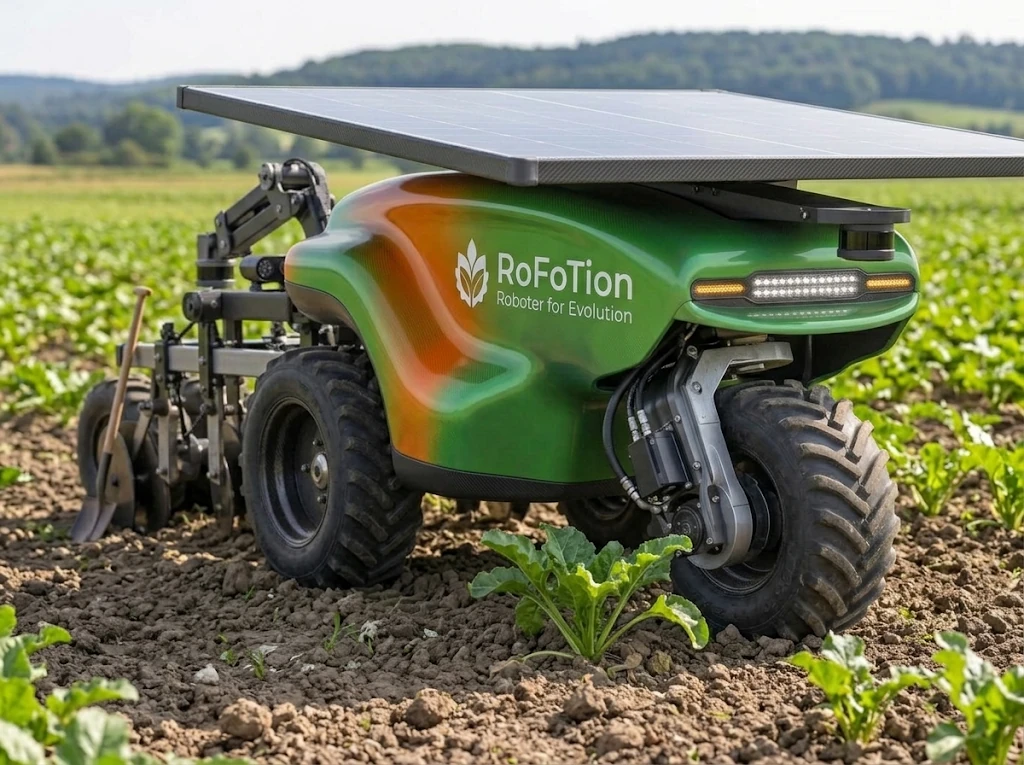
SOLAR-POWERED AGRICULTURAL ROBOTICS
Solar-powered tillage, furrowing, clearing, and irrigation from a single autonomous machine — backed by a service network built to keep it running where others break down.
Farms struggle to find people for field work, and every season it gets harder to staff.
Large tractors and single-task machines are expensive and sit unused for much of the year.
Conventional field work burns fuel and puts heavy loads on the soil.
Many small and mid-size farms sit in the gap: too big to ignore automation, too small to buy it.
This is not a distant problem. We develop the machine in Germany, and German farms feel the same squeeze: field workers are hard to find, machines are expensive and sit idle between jobs, and diesel passes get harder to justify.
We built the service system first, then the robot around it.
Instead of one machine per task, we build one platform that adapts through swappable modules. Interchangeable tool modules mount to the same chassis, so one machine earns its keep across the whole season.
Prepares soil at depth across compacted, dry, and variable terrain. Adaptive to sandy, clay, and lateritic soils.
Precision row formation for planting, calibrated per crop and spacing requirement.
Mechanical clearing that replaces chemical herbicide passes. Restores degraded and abandoned land.
Controlled water delivery with volumetric measurement, reporting cubic meters per hectare in real time.
Every operation is logged. Every hectare is measurable. Every report is audit ready.
Replaces diesel in field work. Plans tasks around the power available. Records energy used per job.
Panel on the robot roof
Buffers energy for work
Plans each job around available power
Tillage, furrowing, clearing, irrigation
Our monitoring and evaluation framework is designed to satisfy the reporting standards of development finance institutions and national agriculture programs. Hectares mechanized, cubic meters of water saved, cost per hectare against baseline, uptime, repair time, and jobs created, all exportable and independently verifiable.
Hectares mechanized
m³ water per hectare
Cost per hectare
Uptime
Mean time to repair
Operators certified
$14.3 B
Global agricultural robot market in 2024
$56.3 B
Forecast for 2030
$9 B
Venture capital into on-farm tech in 2025, up 7 % year-on-year
~17,000
Agricultural robots sold in 2025
MarketsandMarkets (2025), AgFunder AgriFoodTech Investment Report 2026, IFR World Robotics 2026
We develop and build the platform in Germany. Our founding market is German agriculture: development, testing, and first deployments all happen here. Further markets — across Europe, Sub-Saharan Africa, MENA, and Latin America — will follow.
Home market: development, testing, and first deployments.
Founding market
The next step after the home market is validated.
Future market
A mechanization gap across all farm sizes — smallholder plots and large commercial estates alike.
Future market
Strong sun and real irrigation challenges: water-scarce regions with growing demand for autonomous field work.
Future market
Large farm structures, rising labour costs, and irrigation challenges of their own.
Future market
Done
Done
Next milestone
Planned
Planned
Planned
Phases, not dates: timing depends on funding and on finding the right partners.
We are speaking with agriculture ministries, development finance institutions, cooperatives, equipment distributors, and mechanization entrepreneurs. Tell us which one you are.